
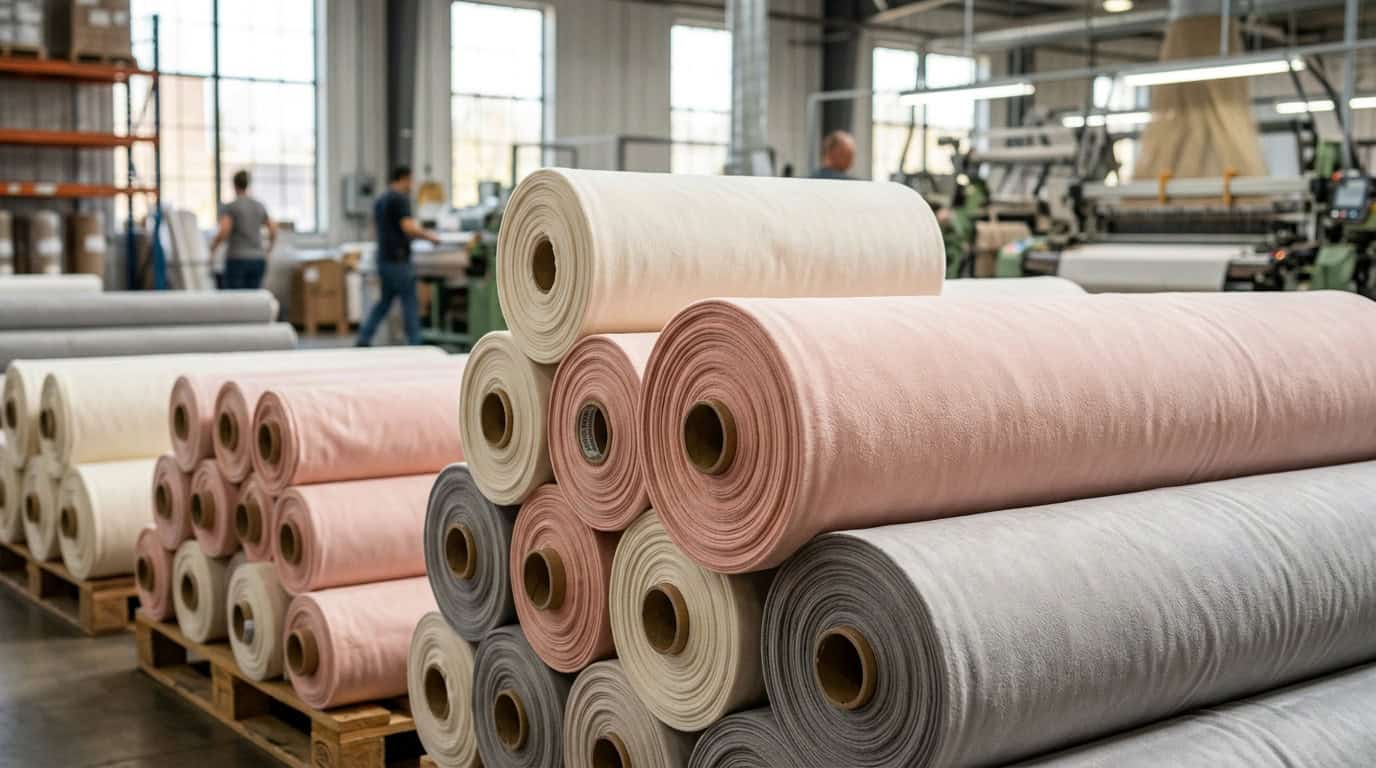
If you are comparing Autumn Canton Fair textile suppliers for a 100% polyester microfiber bedding fabric programme, the question that decides the order is not who has the widest stand. It is which microfiber bedding fabric manufacturer in China can quote a lower ex-works price without thinning the fabric, and then ship two containers a day while you are still in Guangzhou.
Perfectextile has run that comparison from the mill side since 2004. Our answer is short: our price is lower because of where we make the fabric and how much of the chain we own, not because we cut grams per square metre. A container of dyed or bleached microfiber bedding fabric leaves our plant in 15 to 20 days after deposit and lab-dip approval, and we load two 40HQ containers a day.
That is the window when a bedding wholesaler can walk a factory’s own stand, feel the hand of a brushed fabric such as peach skin fabric, and then hold the supplier to the same numbers at the plant.
This is not another fair guide. It is the evaluation we would want a bedding wholesaler to run on us, with the numbers we publish and the checks you can make yourself.
Why Our Price Is Highly Competitive
A mill’s ex-works price tells you very little on its own. What matters is what that price buys: the construction behind it, the tolerance it is held to, and the cost lines the mill can actually explain. Our price is lower than most coastal quotes at the same construction, and the reason is structural rather than a thinner fabric. Energy, regional policy and the number of hands the yarn passes through explain the gap. For buyers comparing Autumn Canton Fair textile suppliers, the useful question is not who quotes lowest but which quote survives a specification check, so here is how we read a price sheet and where ours comes from.
Start with power, because dyeing and finishing are the heat- and power-heavy steps in any mill. Rhodium Group’s estimate of China’s industrial power price puts the national industrial rate at 0.6 to 0.8 RMB per kWh, roughly USD 0.085 to 0.11, in its March 2025 assessment. A plant buying inland power carries a structurally lower conversion cost than one buying coastal power, and conversion cost is where most of a quote’s movement sits once the construction is fixed. We do not publish a per-kWh regional comparison, because no single dataset supports one. What we can tell you is that our plant runs in Northwest China, where power and land are priced for industry.
Scale is the second line, and it is the one a buyer can test from the outside. WTO value-chain data on the textile sector shows textiles and clothing at 3.7% of world merchandise exports in 2022, with China holding more than 40% of the value added in global exports of the sector. That concentration comes from long, integrated runs. A plant weaving more than 80 million metres a year spreads fixed cost across far more metres than a trader sourcing from three small workshops, and the per-metre fixed cost shows up in the quote.
The third line is the market itself, and it is the reason a suspiciously low number deserves scrutiny rather than applause. The NBS 2025 profit release for industrial enterprises recorded a 12.0% fall in textile-mill profit for 2025, against a 5.0% rise across manufacturing overall. When margins compress that hard, some factories quote below cost to keep looms running and recover the difference in the fabric. That is the real risk behind a bargain, and it is why we put our cost structure on the table instead of matching a number.
So what do you get at our price? Bleached white and dyed fabric at 150 to 315 cm wide and 65 to 140 GSM; printed microfiber fabric at 150 to 280 cm and 60 to 135 GSM; embossed, satin, ultrasonic, quilting and seersucker at 175 to 300 cm and 65 to 135 GSM. Every order is fully inspected before packing, and we issue lab reports for GSM and wash cycles on request.
⚠️ Warning Verify GSM on finished, conditioned fabric, not from a quote sheet. Weight measured off the loom or before conditioning reads high, and a 5 GSM shortfall on a 70 GSM sheeting is a visible change in hand feel. Agree the lot tolerance in writing and test the bulk sample, not the development sample.
The objection we hear most is that a lower price must mean a thinner fabric. It does not, provided the specification is pinned down before the order. Standard bedding-fabric sourcing practice is to tie the decision to an approved bulk sample plus a written spec, a named test plan and a pre-shipment inspection procedure, with GSM measured on finished, conditioned fabric against an agreed lot tolerance. That is the framework we work to, and it is what makes a price comparison meaningful: two quotes at different GSM are not two quotes for the same product.
Northwest Factory Relocation Advantage
We moved production to Northwest China in 2025, and every order we ship today comes out of that plant. The relocation is the single largest reason our ex-works price sits where it does, and it is also the question buyers ask first, so here is the plain answer: the plant is fully operational, it covers 66,780 m², and it is the only site filling current orders.
The economics are straightforward. Western China carries policy support designed to pull manufacturing inland, and energy and land cost less there than on the coast. A dyehouse and finishing line are among the most energy-intensive assets in a textile plant, so siting them where power is cheaper lowers the conversion cost on every metre. That saving is what lets us quote factory-direct polyester fabric below coastal mills without touching the construction.
What the move did not change is the specification. The same 65 to 140 GSM dyed range, the same 150 to 315 cm widths, the same full inspection before packing. If you are evaluating us at the fair, ask for the plant address and the production line behind your quote. A relocated plant still ramping up will show it in lead times, and ours are published in the capacity section below.
Vertical Supply Chain
Everything from textured yarn to the packed roll happens under one roof, which is why there is no intermediary margin inside our price and no third party to blame when something goes wrong. Yarn texturing and weaving run into brushing, dyeing, printing, finishing, inspection and packing as one sequence.
Quality control is where the vertical setup earns its keep. Before packing we check fabric weight and width, inspect colour shade, inspect for defects, then review the packed shipment before it leaves. Four checkpoints, each with a record, on a single site. That is also the criterion we would apply to any mill: ask which of those checks happen in-house and which are outsourced, because the outsourced ones are where disputes start.
Certifications are options we confirm per order, and you can verify them without trusting a hangtag. OEKO-TEX’s label check returns a result only for a valid certificate or label number, and the numbers are case sensitive. OEKO-TEX classifies bed linen in Product Class 2, the direct-skin-contact class, tested against more than 1,000 harmful substances, with a certificate issued for one year.
Pro Tip On a recycled order, ask for the scope certificate and the Transaction Certificate for your shipment. The scope certificate shows the site is certified; the Transaction Certificate carries the recycled percentage for that batch. One without the other proves nothing about your goods.
Capacity & Delivery
Two 40HQ containers leave our plant every day, and a full container of regular microfiber bedding fabric ships in 15 to 20 days after the 30% deposit and lab-dip approval. Those are the two numbers that decide whether a wholesaler can hold a season, so here they are in full.
Measure | Figure |
|---|---|
Established | 2004 (22 years) |
Factory area | 66,780 m² |
Daily output | 2 × 40HQ containers |
Annual output | More than 80 million metres |
Lead time, regular order | 15–20 days per 40HQ after 30% deposit and lab-dip approval |
Lead time, embossed | 20–30 days |
Lead time, print | 25–30 days |
Lead time, stripes | 30–45 days |
MOQ, bleached and dyed | About 2,000 m per colour |
MOQ, embossed | 2,000 m per colour |
MOQ, print | 5,000 m per design (all colours in one design count toward it) |
MOQ, stripes | 5,000 m per colour |
Payment | TT 30% deposit, balance against B/L copy; L/C at sight for new customers |
Shipping | By sea or by train |
As a microfiber bedding fabric manufacturer China buyers return to, Perfectextile holds that lead time through fair season because production never stops for the show. The same lines supply the full range of microfiber bedding fabric applications, from duvet covers and comforter shells to pillowcases and mattress protectors. The dates to plan around are the changeovers: the Canton Fair’s own phase and category listing shows Phase 3 running 31 October to 4 November 2026, with the complex closed to exhibitors on 28 to 30 October. Book your Phase 3 days first, then your mill visit.
The tests you should name in the spec are the ones that predict how the fabric behaves in a customer’s laundry. The accelerated laundering test (AATCC TM61) approximates five typical hand or home launderings in one 45-minute cycle. The ISO 105-C06 laundering test allows one multiple test to stand in for up to five domestic launderings at temperatures not exceeding 70 °C. Pilling is measured by the modified Martindale pilling test (ISO 12945-2), with results graded visually at defined rub stages. Shrinkage specimens are marked and measured to ISO 3759, and colour transfer by rubbing is checked with the crocking test (AATCC TM8).
If you sell into the United States, the labelling rules are worth building into the order now. The FTC’s textile labelling guidance requires generic fibre names and percentages in descending order, fibres under 5% disclosed as “other fibre”, and the country of origin, all in English. CPSC’s guide to US textile requirements sets out the Flammable Fabrics Act and the standards behind it, including 16 CFR 1610 for clothing textiles and 16 CFR 1632 and 1633 for mattresses and mattress pads. Your own product classification decides which applies; confirm it before the fabric is cut.
Key Takeaway 66,780 m², two 40HQ containers a day, more than 80 million metres a year, 15 to 20 days per regular container, and MOQ from 2,000 m per colour. Those five figures are the whole capacity case.
Call to Action
The fastest way to settle a price question is to hold the fabric. Our microfiber bedding fabric range, including peach skin fabric and printed microfiber fabric, is specified on the site so you can see the constructions before you ask for a quote. We mail a free A4 swatch pack, and if you send us a swatch of the fabric you are buying today, our laboratory will analyse it and tell you what construction you are actually getting.
That matters most when a quote looks too good. A lab comparison of your current fabric against ours answers the “what was traded away” question in grams and wash cycles rather than adjectives, and it costs you nothing but the postage on your side.
If you cannot make the fair, or you would rather see the line than a stand, book a 20-minute video walk-through. We will take you through the weaving, dyeing and inspection areas live, show the packed rolls going out, and answer spec questions on the call. It replaces a booth visit without the flight.
Packing is confirmed at order stage and written into the contract: roll packing, single-fold or double-fold rolling, bale packing or vacuum packing, with paper-tube diameter and small-roll packing agreed in writing. Payment is TT with 30% deposit and balance against B/L copy at sight, or L/C at sight for new customers.
Request the free A4 swatch and tell us your market, width and GSM target. Book a 20-minute video walk-through and bring your current fabric to the call. Either way, you will have the numbers before you place a container with Perfectextile.
 English
 Arabic
 Spanish
 French
 Italian
 Portuguese
 Vietnamese