
Quilted vs Ultrasonic Fabric: What Is the Difference?
Stitched quilted fabric and ultrasonic quilted fabric can both be used to join a face fabric, filling layer and backing material. The main difference is how those layers are connected.
Traditional quilting uses needle and thread, while ultrasonic quilting uses high-frequency vibration to bond compatible thermoplastic materials. The right option depends on the product structure, desired appearance, filling weight, order volume and target price.

Quilted vs Ultrasonic Fabric: Quick Comparison
The following comparison summarizes the main differences buyers should consider before confirming a bedding or home-textile construction.
| Facteur | Stitched Quilted Fabric | Ultrasonic Quilted Fabric |
|---|---|---|
| Joining method | Needle and sewing thread | High-frequency vibration and pressure |
| Suitable materials | Broad material compatibility | Best suited to compatible thermoplastic fibers, especially polyester |
| Surface appearance | Visible stitches and fuller relief | Clean bonded pattern without sewing thread |
| Loft | Usually fuller and softer | Usually flatter and more compact |
| Pattern flexibility | Highly flexible stitching designs | Pattern depends on roller or mold design |
| Production speed | Relatively slower | Faster for continuous bulk production |
| Thread breakage risk | Possible | No sewing thread |
| Cost structure | Includes sewing labor and thread | Requires suitable machinery and tooling but can be efficient at volume |
| Washing performance | Depends on thread, stitch density and construction | Depends on bonding strength, material compatibility and production settings |
| Typical bedding use | Comforters, quilts, mattress pads and premium padded products | Bedspreads, coverlets, lightweight quilts and decorative bedding panels |
What Is Stitched Quilted Fabric?
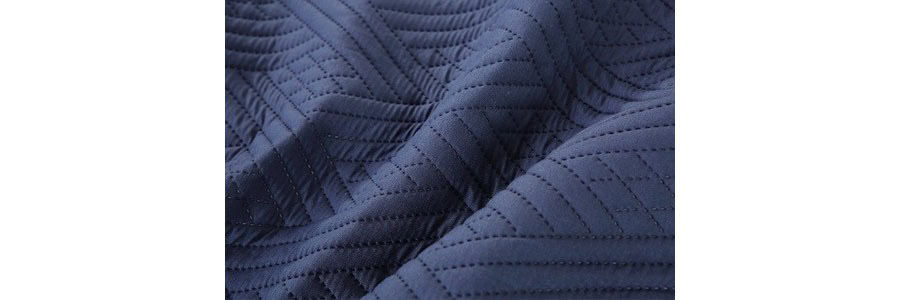
Stitched quilted fabric is produced by sewing through a face fabric, filling layer and backing material. The stitching holds the layers together and creates the visible quilt pattern.
This method offers considerable flexibility in stitch spacing, pattern shape and material selection. It is often used when the buyer wants a fuller appearance, thicker filling or more detailed decorative stitching.
The final performance depends on thread quality, stitch density, filling distribution and the stability of the face and backing fabrics.

What Is Ultrasonic Quilted Fabric?
Ultrasonic quilted fabric uses high-frequency mechanical vibration and pressure to create localized heat at selected bonding points. Compatible thermoplastic layers, particularly polyester-based materials, are pressed together to form a repeated pattern.
Unlike stitched quilting, the process does not require sewing thread. The design is normally created by an engraved roller or mold, which makes the method suitable for consistent repeat patterns and continuous bulk production.
Bonding quality depends on material compatibility, fabric weight, filling structure, pressure, temperature-related settings and production speed.
Ultrasonic quilting is not suitable for every fiber composition. Materials must contain sufficient thermoplastic content to form a stable bond.
Quilted vs Ultrasonic Fabric: Key Differences
Méthode de construction
Stitched quilting relies on needle and thread to join the layers, which means seam and stitch quality directly affect the finished construction. Ultrasonic quilting uses vibration to bond compatible thermoplastic layers, so no thread is present at the bonding points, and material compatibility becomes the main factor buyers need to confirm before placing an order.
Appearance and Loft
Stitched quilting usually creates a fuller and more dimensional appearance, particularly when thicker filling is used. Ultrasonic quilting normally produces a flatter, cleaner and more compact surface. Neither appearance is universally better; the right look depends on the product's intended market position and target retail price.
Pattern Flexibility
Buyers who need a fully customized design usually find stitched quilting easier to adapt, since stitch spacing and pattern shape can be adjusted without new tooling. Ultrasonic quilting patterns depend on the roller or mold used, so switching to a new pattern may involve tooling cost and a minimum order quantity, while an existing pattern supports consistent, repeatable bulk orders at lower unit cost.
Durability and Washing Performance
Neither method is automatically more durable in every application. Stitched quilting performance depends on thread quality, stitch density and seam stability. Ultrasonic quilting performance depends on bonding strength, fiber compatibility and production settings.
For both constructions, wash testing should be completed before bulk production when the finished product has specific laundering requirements, since this is the point where quality issues are most likely to surface.
Production Efficiency and Cost
For large-volume repeat orders, ultrasonic quilting is often the more cost-efficient route because it removes sewing labor and thread cost and supports continuous production. However, tooling and pattern setup should be budgeted for new designs, and material compatibility must be confirmed in advance.
Stitched quilting may carry higher per-unit sewing cost and lead time, but it gives buyers more room for customized patterns, heavier fillings and premium product positioning where flexibility matters more than unit price.

Quilted vs Ultrasonic Fabric for Bedding Applications
The better option depends on the product, target market, filling weight, surface effect and required price level.
| Product / Application | Commonly Suitable Option | Main Reason |
|---|---|---|
| Premium thick comforter | Stitched quilting | Greater loft and pattern flexibility |
| Lightweight bedspread | Ultrasonic quilting | Clean surface and efficient repeat production |
| Decorative coverlet | Either | Depends on desired texture and price point |
| Mattress pad | Either | Depends on filling, backing and wash requirements |
| Promotional bedding | Ultrasonic quilting | Suitable for repeat patterns and larger volumes |
| Customized premium design | Stitched quilting | Greater flexibility in stitch design and construction |
| Lightweight quilted panel | Ultrasonic quilting | Compact structure and thread-free pattern |
These are general guidelines rather than fixed rules. Final selection should be based on the complete construction and approved sample.
How Buyers Should Specify Ultrasonic Quilted Fabric Orders
A complete order specification helps avoid delays and mismatched samples. The points below are typically confirmed before quotation and before bulk production.
- Face fabric materialConfirms fiber content and compatibility with the bonding method.
- Face fabric constructionWoven or knitted structure affects hand feel and drape.
- Face fabric GSMWeight per square meter, tied to durability and cost.
- Filling materialAffects loft, warmth and bonding behavior.
- Filling weightDetermines thickness and finished product feel.
- Backing materialAffects stability, feel and total construction weight.
- Finished widthConfirmed against cutting and product size requirements.
- Pattern designExisting roller patterns are more economical than new tooling.
- Color or printSolid dyed or printed face fabric, confirmed against a color standard.
- Finished applicationBedspread, coverlet, mattress pad or another end use.
- Washing requirementGuides wash testing before bulk approval.
- Order quantityAffects pricing tier and lead time planning.
- Roll or bale packingConfirmed based on shipping method and downstream cutting process.
- Sample approval requirementRecommended before bulk production on any new construction.
Quality Inspection Points Before Bulk Production
- Bonding points are even
- Pattern is clear and correctly aligned
- No visible delamination
- Filling is evenly distributed
- Fabric surface is not distorted
- Finished width meets tolerance
- GSM meets approved specification
- Color and print remain consistent
- Bonded areas remain stable after wash testing
- Roll or folded packing does not damage the surface
A bulk order should be evaluated against the approved sample rather than only against a general product description. Pattern clarity, bonding stability, width, GSM and wash performance should be confirmed before shipment, following our fabric quality control process.
Ultrasonic Quilted Fabric Options from Perfectextile
Perfectextile supplies ultrasonic quilted microfiber fabric for bedding and home-textile applications. Available constructions can be developed according to the required face fabric, filling, backing, width, pattern, color and packing method.
Our team can support:
- 100% polyester microfiber face fabric
- Dyed or printed surface options
- Different face fabric and filling weights
- Multiple ultrasonic pattern options
- Custom width and packing
- Sample confirmation before bulk production
- Batch inspection for pattern, bonding, width and GSM
For a broader view of our fabric range, see our microfiber bedding fabric options, or check OEM fabric specifications for private-label orders.
Ultrasonic quilting removes sewing thread from the bonding process and can support efficient continuous production. However, total environmental impact still depends on fiber type, filling, energy use, product lifespan and recyclability.
For details on how our fabric is made, see our fabric manufacturing process.
Foire Aux Questions
No sewing thread is used at the bonding points. Bonding is created through ultrasonic vibration and pressure. Edge finishing may still use other sewing processes depending on the finished product.
Pure cotton is not naturally thermoplastic. Ultrasonic bonding normally requires polyester or another compatible thermoplastic component. Blended or layered constructions may be possible after testing.
It can be washable. Performance depends on material, bonding settings and construction. Wash testing should be completed for the intended product before bulk approval.
There is no universal answer. Stitched durability depends on thread quality and stitching. Ultrasonic durability depends on bond strength and material compatibility. Evaluate by application and wash test.
Yes, depending on the roller or mold used. Existing patterns are more economical. A new pattern may require tooling cost and a minimum order quantity.
Lightweight bedspreads often use ultrasonic quilting. Thick premium comforters often use stitched quilting. The final choice depends on fill weight, loft, target price and design.
Face material, GSM, filling, backing, width, pattern, color or print, quantity, application and packing. Providing these details in advance speeds up an accurate quotation.
Need Help Choosing the Right Quilted Construction?
Send us your target face fabric, filling weight, backing material, finished width, pattern, application and order quantity. Our team can recommend a suitable stitched or ultrasonic construction and prepare samples for approval.
 French
 English
 Arabic
 Spanish
 Italian
 Portuguese
 Vietnamese