
Choose a bed sheet fabric manufacturer by checking product fit, production responsibility, sample approval, quality records, delivery planning and how problems will be handled. Ask for evidence relevant to your order. A factory photograph, an attractive sample or a certificate on its own does not establish that a supplier can reproduce your required fabric in bulk.
This checklist is for importers, fabric wholesalers and bedding manufacturers sourcing fabric rolls. Buying finished bed sheet sets involves additional requirements such as finished dimensions, sewing, components and retail packing; it should not be treated as the same purchasing specification.
Updated: 2 November 2026.
Define what you need before comparing manufacturers
Start with the finished application, required material, construction, quality level, quantity, packing and delivery window. If you are buying 100% polyester woven bedding fabric, confirm that the supplier’s relevant capability is in that product rather than assuming that a broad home-textile catalogue proves expertise.
For detailed GSM, width, brushing and quotation checks, use our wholesale bedding fabric specification guide. The questions below focus on the supplier’s ability to deliver the agreed specification.
Check the company, brand and factory relationship
A brand name, sales company and production facility may have different names. Ask the supplier to explain how they relate and identify the legal company that will appear on the quotation and order documents. Check that the documents describe the same agreed transaction and production arrangement.
Perfectextile is the brand of Pengfei Textile, the factory name familiar to many of our customers. This brand-and-factory relationship should not be confused with the full legal company name used on formal documents. When requesting a quotation, ask our team to confirm the relevant contracting entity and production location for your order.
A trader or sourcing company is not automatically unsuitable, and a company calling itself a manufacturer is not automatically reliable. What matters is whether production responsibility, quality control, communication and commercial responsibilities are transparent.
Map the production stages and who controls them
Ask which stages are performed in-house and which are subcontracted. Outsourcing is not automatically a problem, but you should understand who selects the subcontractor, approves changes and remains responsible for the finished fabric.
| Production stage | What to ask the supplier |
|---|---|
| Yarn and weaving | Who confirms yarn and construction? How are width, density and greige-fabric defects controlled? |
| Brushing and finishing | Who controls the brushing side, surface effect, hand feel and finishing recipe? How are changes approved? |
| Dyeing and printing | Where is the work performed? Who approves lab dips or strike-offs and checks shade or print registration? |
| Inspection | Who inspects the finished fabric? Which items are recorded, how is the material sampled and how are defects handled? |
| Packing and dispatch | Who confirms roll length, labels, packing, batch identification and shipment readiness? |
Request evidence that matches the process being discussed: a relevant production walkthrough, a live factory visit where feasible, dated records or an inspection example with confidential information removed. A machinery count is not the same as confirmed available capacity for your order.
See Perfectextile’s fabric manufacturing process for an overview of the production stages described on our website.
Turn sample approval into a written bulk standard
A sample should establish what production must match. Keep a traceable reference and a specification sheet that both sides can identify. If a supplier changes the yarn, processing route or finish after approval, require the change to be reviewed before production continues.
- Record the sample reference, date, material, yarn or construction, finished GSM and usable width.
- Agree the permitted tolerances and how the measurements will be made.
- Confirm brushing side, reference hand feel and appearance before and after the agreed wash.
- For dyed fabric, approve the color reference or lab dip. For printed fabric, approve artwork, repeat size and a strike-off where required.
- Record required tests, test conditions and acceptance limits before approving bulk production.
- Name the person who can approve the sample and any later changes.
Example: if a buyer specifies 240 cm usable width, a sample label stating only “240 cm width” leaves an avoidable ambiguity. Confirm whether that number means full width or cuttable width, and record the required minimum and tolerance. This example illustrates a specification question; it is not a claim about a particular order.
Evaluate quality control using records, not slogans
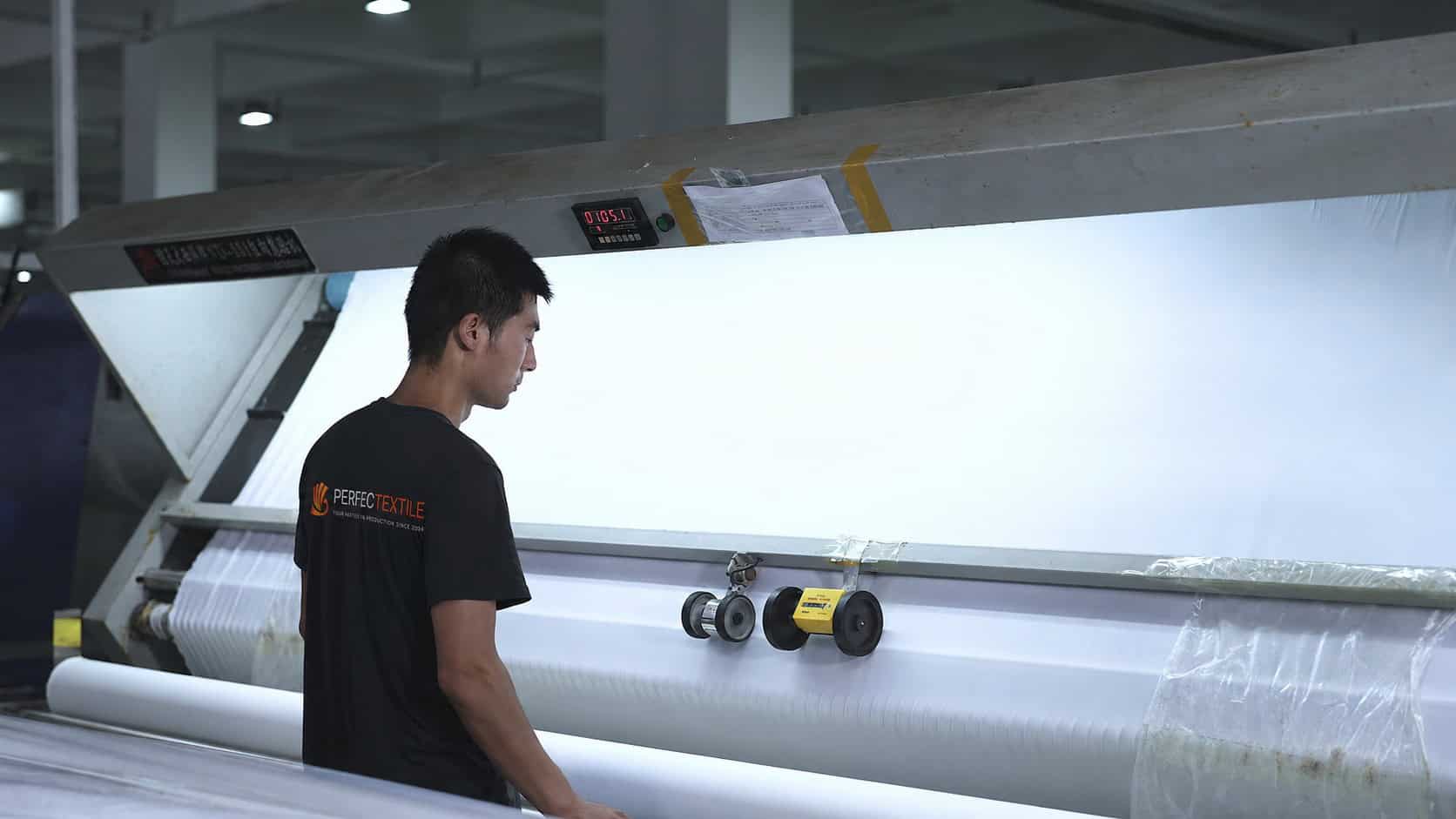
Ask the supplier to show how inspection findings are linked to a roll or production batch. An inspection report is more useful when it states what was checked, how it was sampled, the results and the acceptance criteria. “High quality” or “export quality” does not replace those details.
| Quality-control question | Evidence to request |
|---|---|
| How is shade consistency checked? | The agreed color reference, viewing conditions and a procedure for sample-to-bulk and roll-to-roll comparisons. |
| How are defects recorded? | An inspection example showing defect identification, roll references and the agreed acceptance system. |
| How are physical specifications confirmed? | Records for width, GSM and other order-specific checks under defined measurement conditions. |
| How is performance verified? | Relevant test reports or agreed testing arrangements tied to the actual material and order requirements. |
| What happens when a result is outside tolerance? | A clear review, segregation, rework or rejection process, with buyer approval where required. |
Do not assume a single test proves every aspect of performance. Washing colorfastness, rubbing fastness, pilling and dimensional stability address different questions. The required methods and limits should reflect the intended product and market. Our quality-control page describes the checks considered across production and shipment preparation.
Verify certification scope before using a claim
If your program requires certification, ask for the exact standard or scheme, certificate holder, certificate number, validity and covered products. Verify the details through the relevant issuing body’s official channels. Check whether the document applies to the proposed fabric, production site and order conditions.
Keep certification and performance testing separate. Do not infer that a certified option means every product from a supplier has the same coverage, or that certification guarantees all wash, shrinkage, durability or environmental claims. Request only the documentation relevant to your buyer’s actual requirement.
Check delivery planning and repeat-order control
Ask what starts the lead-time clock: specification approval, receipt of deposit, artwork confirmation or another agreed milestone. Separate sample development, production, testing, inspection and shipment readiness. A general lead-time statement is less useful than a schedule for your actual order.
- Confirm MOQ by color or design and any total-order requirement.
- Ask how the order fits the current production schedule, including peak-season constraints.
- Identify the person responsible for progress updates and exception handling.
- Agree how a delay or failed inspection will be communicated and reviewed.
- For repeat orders, retain the previous approved sample and production specification. Reconfirm shade, hand feel and permitted changes rather than relying on a product nickname.
Clarify packing, inspection and claim handling
Before order confirmation, record the packing format, roll length and tolerance, labels, protection requirements and any identification needed for your warehouse or cutting room. Agree when inspection can take place and whether a buyer-appointed inspector will be involved.
Also agree what to do if a discrepancy is found after arrival: whom to contact, the notification period, which records or samples are required and the review process. Keep these terms in the order documents. A promised remedy should be specific enough for both parties to understand, not an unsupported guarantee in a marketing article.
Copy this manufacturer evaluation checklist
| Question for the supplier | Record before deciding |
|---|---|
| What exactly are you supplying? | Fabric rolls or finished products, composition, product range and relevant construction capability. |
| Who is responsible for the order? | Brand, contracting company, production location and the main contact. |
| Which processes are in-house or outsourced? | The process map, subcontracting responsibilities and change-approval procedure. |
| What defines the approved quality? | Reference sample, specification sheet, tolerances and required tests. |
| What evidence supports quality control? | Relevant inspection records, batch or roll references and nonconformity handling. |
| Do required documents cover this product? | Verified certificate or report scope, validity and order applicability. |
| Can the schedule be met? | MOQ, milestones, production allocation and agreed delivery basis. |
| How will issues be resolved? | Inspection arrangements, packing requirements and documented claim-review steps. |
Frequently asked questions
Is a factory always better than a trading company?
Not automatically. Compare product knowledge, transparency, control of production, accountability and the ability to deliver your specification. Verify the operating arrangement instead of deciding from the company label alone.
Does a good sample guarantee the same bulk quality?
No. A sample is a reference, not a guarantee. Written specifications, traceable approval, production controls and agreed inspection are needed to evaluate bulk consistency.
Should I choose the lowest quotation?
Compare only after matching specifications, quantity, packing and trade terms. Then consider quality evidence, delivery planning and issue handling. A lower number may reflect a different product or scope.
What should I send when contacting a manufacturer?
Send the destination market, bedding application, composition, GSM, usable width, construction or reference sample, color or print, quantity, packing and required timing. Include relevant testing or certification requirements at the start.
Discuss your fabric sourcing requirement
Perfectextile supplies polyester microfiber bedding fabrics to B2B buyers. Review our dyed fabric and printed fabric options, or explore OEM fabric development. Contact our team with your specification or reference sample to confirm a suitable production and approval approach.
 English
 Arabic
 Spanish
 French
 Italian
 Portuguese
 Vietnamese